
Volume 1 · Issue 4 · October 2026
When Conviction Becomes Risk
Reality, reputation, and the discipline of rejudgement after the decision.
Dr. Nadine Richards · Nadine Inspires® ·

Recognition
When a Decision Starts Defending Itself
There is a moment in the life of a consequential decision when something shifts.
The decision stops being examined and starts being protected.
Contrary evidence is reframed as premature. Sceptics are managed rather than heard. Progress reports emphasise what is working. Questions about the underlying premise are treated as disloyalty or misunderstanding. The institution begins spending energy defending the decision rather than learning from its execution.
This is not always dishonesty. It is often something more ordinary: the accumulated weight of commitment.
Capital has been deployed. Reputations have been attached. Relationships have been built around the strategy. People have been hired, promoted, or moved because of it. The institution has told its stakeholders what it believes. Reversing course now carries costs that were not present when the decision was first made.
None of that makes persistence wrong. But it does mean that the institution is no longer evaluating the decision on the same terms it used when the decision was made.
The question is whether the institution can still tell the difference.
The signal is not that the decision is failing. The signal is that the institution has stopped being able to ask whether it is.
That is the moment this issue examines.
Not the moment a decision is made. Not the moment it clearly fails. The moment in between, when conviction and risk have quietly changed places.
Insight
Conviction Can Outlive Its Evidence
Reconsideration is often treated as the opposite of conviction. It is not.
There is a difference between changing one’s mind and rejudging a decision. Changing one’s mind can be reactive. Rejudgement asks whether what warranted commitment then still warrants commitment now.
That distinction matters because reality does not always prove the original decision wrong. Sometimes implementation reveals what could not have been known at the time of commitment.
Ronald Klingebiel and Arnoud De Meyer examined how managers encounter previously unknown uncertainty during implementation. Acting on a strategy does more than execute existing knowledge. It creates new knowledge. The evidentiary environment changes after the decision is made.1
Leaders face a harder problem: what carries influence inside an institution does not necessarily warrant that influence forever. Institutional Judgement™ names that distance.
Before a decision, a financial forecast may warrant considerable weight. Six months into execution, actual performance may warrant more. A CEO’s experience may deserve influence when the strategy is chosen. It should not make contrary evidence less credible once the strategy is underway. A unanimous board vote establishes legitimate authority. It does not establish permanent truth.
A public commitment can explain why reversal would be costly. It cannot, by itself, establish that persistence is wise.
The danger begins when the institution can no longer distinguish evidence for the decision from evidence of its commitment to the decision.
A strategic plan is not made wiser by being five years long. An acquisition does not warrant the next hundred million dollars because the first hundred million has already been spent. A promise does not become evidence because it was made publicly.
A leader can remain faithful to a decision long after the decision has ceased being faithful to reality.
Consequences
Why Leaders Double Down on a Failing Strategy
Management scholarship has examined escalation of commitment for decades: people and organisations can continue investing in a course of action even after negative information begins to weaken the case for continuing.
The explanation is often written as a catalogue of bias. Sunk costs. Loss aversion. Self-justification. Overconfidence. Completion. Personal identification with a prior choice. Those mechanisms matter. They are not the whole story.
Persistence also has a reputation.
Charles Dorison, Christopher Umphres, and Jennifer Lerner found across preregistered experiments that people who escalated commitment were perceived as more trustworthy than those who de-escalated. In one experiment, observers entrusted the people who stayed the course with 29 percent more money.2
The social lesson is difficult to miss.
We tell leaders to change course when the evidence changes. Then we may trust them more when they do not.
Consistency can look like integrity. Persistence can look like strength. Reconsideration can look like uncertainty.
Separate research on public commitment has found that overconfidence can intensify escalation when decisions are visible to others.3
Reputation, then, is not merely something a bad decision can damage. Reputation can become part of the mechanism that prevents rejudgement.
A chief executive has told the organisation the transformation will work. A superintendent has told families a restructuring is necessary. A hospital executive has defended a commercial partnership. A foundation president has repositioned the institution around a new strategic direction. A board has approved an acquisition and publicly expressed confidence in management’s case.
Then the evidence changes.
Now reconsideration creates another question: What will changing course say about us?
Stakeholders may lose confidence because leadership changes course. They may also lose confidence because leadership refuses to.
The institution is no longer judging only the evidence. It is judging the evidence while carrying everything it has already placed behind the decision.
Exhibit 1
When Commitment Begins to Substitute for Evidence
| What changes | What the institution may say | What judgement requires |
|---|---|---|
| Performance | “The strategy needs more time.” | What, specifically, should become true if more time is warranted? |
| Cost | “We have invested too much to stop.” | Ignore yesterday’s spend. What warrants tomorrow’s investment? |
| Reputation | “Changing course will damage confidence.” | Are we protecting institutional trust—or a prior claim of certainty? |
| Leadership identity | “This is our strategy.” | Has ownership begun carrying more weight than evidence? |
| Stakeholder response | “They simply do not understand yet.” | Is resistance noise—or information the institution has failed to interpret? |
Each row names a substitution: something that once supported the decision has quietly begun to stand in for evidence about it.
Evidence
Three Institutions. Three Encounters With Rejudgement.
Target entered Canada with a recognizable brand, significant capital, and a strategy large enough to make retreat expensive.
By January 2015, it had 133 Canadian stores and approximately 17,600 employees. The business had struggled to produce the performance required to justify continued investment. Brian Cornell, who had become CEO months earlier, subjected the operation to a review. Target concluded that it could not identify a realistic path to profitability before at least 2021 and announced that it would leave Canada. The company expected approximately $5.4 billion in pretax losses associated with discontinued Canadian operations for the fourth quarter of 2014.4
The money already spent did not disappear. Neither did the reputational cost of retreat.
What changed was the question. The relevant issue was no longer whether Target had once believed Canada could work. It was whether the next dollar, the next year, and the next organisational commitment were still warranted by what leadership now knew.
Prior investment stopped being treated as sufficient justification for future investment.
Memorial Sloan Kettering Cancer Center confronted a different problem.
Relationships among medicine, scientific research, and industry can move discoveries toward patients. They can also create questions about financial interest, authority, disclosure, and trust.
In 2018, scrutiny of outside financial relationships and disclosure practices led MSK to appoint a conflict-of-interest task force, impose a moratorium on certain board appointments and direct investments connected to MSK start-ups, and strengthen disclosure and oversight.5
The institutional lesson is not that collaboration with industry was inherently wrong. It is that a defensible strategic conviction can require different governance once reality reveals risks the original arrangements did not adequately contain.
Institutions often confuse reconsidering the mechanism with betraying the mission. Sometimes the mission is precisely what requires the mechanism to change.
A third case sits inside public education and is intentionally unnamed.
In 2026, an independent investigation commissioned by a large U.S. school district examined executive travel and relationships with outside vendors. Applying a preponderance-of-the-evidence standard, investigators concluded that policy violations more likely than not occurred in parts of the conduct examined. The report also found no evidence of financial conflicts of interest or improper gifts.6
The names matter less here than the institutional question.
Why does an organisation sometimes need an external investigation before information already present inside the system acquires enough weight to change its judgement?
That is not simply an ethics question. It is a question about institutional intelligence.
People can speak without being heard. Evidence can exist without becoming consequential. A concern can be technically visible while remaining institutionally weightless.
That is why strong institutions cannot depend on individual courage alone. A system that requires heroism every time inconvenient evidence needs to reach authority is not a strong system. It is a fragile one staffed by brave people.
Governance
The Conditions for Rejudgement
Boards know how to approve. The harder work begins when the institution has already moved.
A strategic plan is adopted. A CEO is appointed. An acquisition closes. A campus opens. A service line is launched. Capital has been committed. Management begins executing.
The board should not govern by continually reopening the decision. That would not be stewardship. It would be interference.
But board oversight does not end because approval has occurred.
A board that authorizes a consequential decision does not own its execution. It does own the conditions under which the decision should return.
A problem does not automatically trigger rejudgement. A material change in the conditions that warranted the original commitment does.
Those conditions will differ by decision, but strong boards make them explicit enough to recognise.
A load-bearing assumption changes. A core belief about market demand, enrolment, funding, regulation, talent, technology, cost, or capacity no longer holds as it did when the decision was approved.
Performance materially diverges from the approved premise. The gap is not merely discomfort or early friction. Actual results challenge the logic on which continued commitment depends.
Execution reveals consequences that were not reasonably visible at commitment. Implementation produces new information about risk, people, culture, operations, or interdependence that changes what the decision now requires.
Strategic, financial, human, or reputational risk shifts materially. The institution is now carrying a different risk profile from the one it originally authorised.
Management and the board are no longer interpreting the same reality. The disagreement is not a matter of style. It concerns the meaning of evidence, the status of assumptions, or what warrants continued commitment.
These conditions do not tell a board what answer to reach. They tell the board when the question has become legitimate again.
That is the distinction between governance and second-guessing.
Application
Stay the Course, Adapt, or Reverse?
Leadership language often offers two choices: stay the course or change course. Consequential decisions rarely remain that simple.
Exhibit 2
Persistence, Adaptation, and Reversal Are Different Judgements
| Persist | Adapt | Reverse | |
|---|---|---|---|
| What remains sound | The underlying premise | The purpose | The need to act |
| What has changed | Execution is harder than expected | The route no longer fits reality | The assumptions supporting commitment |
| Judgement required | Carry the decision through difficulty | Change how the purpose is pursued | Stop allowing the prior decision to govern the next one |
| Primary danger | Denial | Drift | Panic |
None is a virtue by itself. The quality lies in the judgement surrounding the response.
Sometimes difficult execution is evidence that the strategy is wrong. Sometimes it is evidence that execution is difficult. Sometimes the purpose still warrants commitment but the method does not. Sometimes the conditions have changed enough that yesterday’s correct answer has become today’s strategic risk.
Rejudgement exists to distinguish among them.
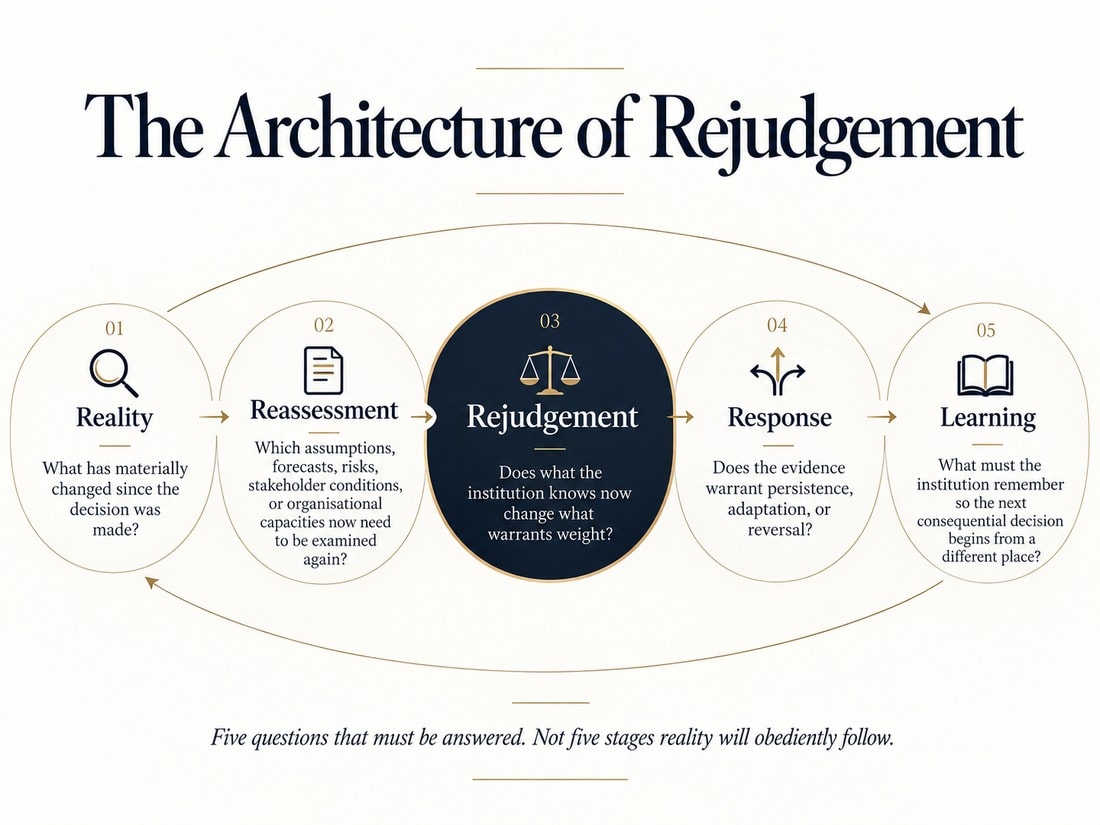
Each question in the framework above is a discipline, not a stage.
Reality: What has materially changed? Not what is uncomfortable or inconvenient. What has actually shifted in the conditions that warranted the original commitment?
Reassessment: Which assumptions need re-examination? Every consequential decision rests on beliefs about the future. Some of those beliefs are now testable. Which ones have been tested, and what did the test reveal?
Rejudgement: Does what the institution knows now change what warrants weight? This is the hardest question. It requires separating what was true when the decision was made from what is true now—and asking whether the institution is still capable of making that distinction.
Response: Does the evidence warrant persistence, adaptation, or reversal? The answer is not always reversal. Sometimes it is staying the course with clearer eyes. Sometimes it is changing the method while preserving the purpose. Sometimes it is stopping.
Learning: What must the institution remember so the next consequential decision begins from a different place? This is where most institutions stop short. They absorb the outcome. They do not always absorb the lesson.
Linda Argote and Ella Miron-Spektor distinguish between organisational experience and organisational learning. Experience is what happened. Learning is what the institution retains in a form that changes its future capability.7
An institution can go through a rejudgement moment—can reverse a strategy, absorb the cost, and move on—without ever learning what made the original decision resistant to reconsideration. The next consequential decision then begins from the same place.
Experience is what happened. Learning changes what the institution is capable of seeing next.
Institutional Humility
What Would Have to Become True?
Every consequential decision should carry an answer to a question that rarely appears in the minutes:
What would have to become true for us to judge this again?
If the answer is nothing, the institution has moved beyond conviction.
If the answer is anything, it never truly committed.
Good judgement lives between those two failures.
That requires conviction. It also requires humility.
Not humility as temperament. Institutional humility.
The capacity to allow reality to remain authoritative after powerful people have already spoken. The capacity to revisit an assumption without turning reconsideration into an indictment of whoever held it first. The capacity to separate consistency from credibility.
That distinction will become more important, not less.
That distinction will become more important, not less. Artificial intelligence will increase the volume, speed, and apparent certainty of information available to decision-makers. It will not resolve the institutional pressures that determine which information is allowed to matter. A system that surfaces contrary evidence faster does not automatically produce an institution willing to act on it.
And no technology removes the institutional pressures that arise once authority, capital, identity, and reputation have attached themselves to a choice.
The danger facing leaders is not simply making a wrong decision. It is allowing an old decision to become too important to question.
The test of institutional judgement is not whether an institution changes its mind. It is whether reality still has enough authority to make reconsideration possible.
Notes
- Ronald Klingebiel and Arnoud De Meyer, “Becoming Aware of the Unknown: Decision Making During the Implementation of a Strategic Initiative,” Organization Science 24, no. 1 (2013): 133–153. The study examines how previously unknown uncertainty can become visible during implementation, changing what managers know about a strategic initiative. ↩
- Charles A. Dorison, Christopher K. Umphres, and Jennifer S. Lerner, “Staying the Course: Decision Makers Who Escalate Commitment Are Trusted and Trustworthy,” Journal of Experimental Psychology: General 151, no. 4 (2022): 960–965. Across preregistered experiments, decision-makers who escalated commitment were perceived as more trustworthy; in one experiment they were entrusted with 29 percent more money. ↩
- Richard Ronay, Janneke K. Oostrom, Nale Lehmann-Willenbrock, and Mark Van Vugt, “Pride Before the Fall: (Over)confidence Predicts Escalation of Public Commitment,” Journal of Experimental Social Psychology 69 (2017): 13–22. The study examined overconfidence and escalation under public versus private commitment conditions. ↩
- Target Corporation, “Target Corporation Announces Plans to Discontinue Canadian Operations,” January 15, 2015. Target reported 133 Canadian stores, approximately 17,600 employees, no realistic path to profitability before at least 2021, and approximately $5.4 billion in expected pretax losses on discontinued Canadian operations for the fourth quarter of 2014. ↩
- Memorial Sloan Kettering Cancer Center, “Memorial Sloan Kettering Cancer Center Announces Conflict of Interest Task Force,” September 21, 2018, which established the task force; and “Memorial Sloan Kettering Announces Policy Changes,” September 29, 2018, which is the source for the moratorium on MSK board members serving on the boards of MSK start-ups or making direct investments in them, together with strengthened disclosure and oversight requirements. ↩
- Caplan and Earnest LLC, independent investigation commissioned by the Cherry Creek School District, Colorado; report dated May 2026. The body of this article leaves the district unnamed because the institutional question, rather than the identity of the individuals involved, is the relevant case. Investigators applied a preponderance-of-the-evidence standard and found that district leaders more likely than not violated policy in matters including personal travel charged to the district and favouritism toward a consulting vendor, while reporting no evidence of financial conflicts of interest or improper gifts. The district subsequently tightened procurement and spending controls, required legal review of contracts, revised travel guidelines, and ordered an outside audit. ↩
- Linda Argote and Ella Miron-Spektor, “Organizational Learning: From Experience to Knowledge,” Organization Science 22, no. 5 (2011): 1123–1137. The article distinguishes organisational experience from learning that becomes retained and available to future action. ↩
Download the Executive Edition
For readers who prefer a designed edition to save, print, or circulate, the October 2026 Institutional Judgement Review is also available as a PDF.
Download the Executive Edition →Executive Strategy Conversation
Some decisions need examination before they are made. Others need examination because they already have been.
A strategy is consuming more capacity than its return appears to justify. A major initiative is producing consequences leadership did not anticipate. A board and executive team are looking at the same evidence and reaching different conclusions. A reputational concern has moved beyond communications into governance. An institution knows conditions have changed but has not yet determined whether the appropriate response is to persist, adapt, or reverse.
Those are rejudgement moments.
An Executive Strategy Conversation is a confidential working session, not a briefing and not a pitch, for leaders carrying a consequential decision that may need to be examined again.
The question is not simply whether the decision is still right. It is what has changed, which assumptions remain credible, what is carrying weight now, and whether that weight is warranted.
Sometimes the answer is to change course. Sometimes the harder answer is to stay. Both require judgement.
Reality before reputation. Judgement before messaging.
If your institution is carrying a consequential decision that reality has begun to challenge, write to me directly and tell me what changed.
Request an Executive Strategy ConversationDr. Nadine Richards
Founder & CEO, Nadine Inspires®
[email protected]